Turn your facility into an intelligent, self-reliant energy hub. Whether paired with solar or installed on its own, a Battery Energy Storage System (BESS) helps commercial and industrial facilities manage rising energy costs, maintain operations during outages, and stabilize performance in an increasingly volatile energy market.
How Battery Storage Works
%20(2).png?width=400&height=200&name=Untitled%20(400%20x%20200%20px)%20(2).png)
A BESS captures electricity from the grid or on-site generation and stores it for use when it delivers the most value — reducing costs, improving reliability, and creating additional revenue streams.
Modern BESS units are managed by intelligent control software (or an energy specialist) that determines when to charge, discharge, or store power.
BESS helps your facility:
- Manage rising energy costs
- Reduce demand charges by shaving short usage spikes.
- Lower time-of-use costs by shifting energy consumption.
- Provide backup power during grid outages.
- Generate new revenue through demand response and PJM market programs.
- Improve power quality to protect sensitive equipment.
- Support EV charging or expansion without costly service upgrades or extended interconnection wait times.
Why Battery Storage Matters Now
The U.S. grid is under unprecedented strain. Explosive growth in AI, data centers, electrification, and manufacturing reshoring has driven electricity demand to record levels after decades of stagnation.
As a result, energy costs are climbing sharply. Utilities are struggling to keep up — causing higher rates, long interconnection delays, and rising outage risks. Capacity prices in the Mid-Atlantic have increased more than tenfold since 2023, driving double-digit rate hikes across New Jersey and neighboring states.
Battery storage helps businesses stabilize costs, optimize when and how they use power, and maintain operations when the grid can’t. With state incentives already active—or launching soon—in New Jersey, California, Connecticut, Massachusetts, Rhode Island, New Hampshire, New York, Maryland, Vermont, and Hawaii, the value case for commercial battery storage has never been stronger.
Integrating Battery Storage into a Complete Microgrid Solution
Battery storage is integral to a microgrid — a self-sustaining system that can operate independently from the utility grid.
When paired with solar and backup generators, a microgrid helps your facility maintain uptime during outages while optimizing energy use for maximum efficiency and resilience.
In short, solar generates, BESS stores, and the microgrid ties it all together. Learn more about Microgrids..
The Business Case for Commercial & Industrial Battery Storage
A Battery Energy Storage System creates multiple layers of financial and operational value.
Each system typically captures several “stacked value streams” that together make BESS one of the smartest long-term infrastructure investments available today.
How Batteries Create Value
The energy savings and revenue below are based on November 2025 electric rates for a facility on PSEG’s Large Power & Lighting Secondary rate with approximately 1 MW of daily demand.
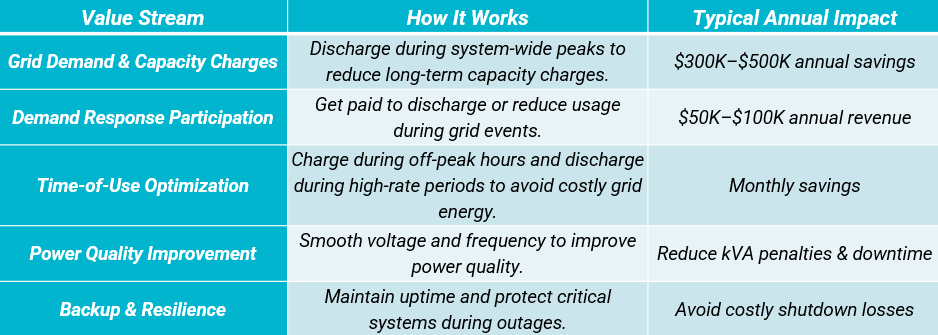
Most facilities capture 3–6 of these value streams — turning one asset into multiple sources of ROI, savings, and resilience.
The Broader Business Impact of Battery Storage
💰Financial Control: Manage and/or reduce energy costs and create new revenue through grid programs.
🏵️ Operational Resilience: Keep operations running through outages, improve power quality, and protect critical loads.
🍃 Sustainability & ESG: Optimize renewable energy use, cut carbon footprint, and demonstrate leadership in energy innovation.
Industries and Facility Types That Benefit Most from Battery Storage
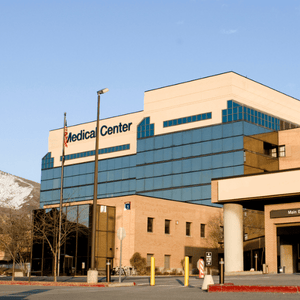
Facilities with high energy demand, mission-critical operations, or strict reliability requirements gain the greatest value from a battery energy storage system. Beyond cost savings and revenue, BESS strengthens operational continuity, improves power quality, and supports long-term sustainability strategies across a wide range of commercial and industrial environments.

Resilience for Critical Operations
Ideal for hospitals, manufacturing, cold storage, logistics, and data centers.
-
Backup for critical loads such as servers, refrigeration, life-safety systems, and production equipment
-
Seamless switchover with no downtime to maintain continuous operations
-
Reduced reliance on diesel generators (and their fuel, noise, and maintenance costs)
-
Resilience for outages, storm events, and grid instability

Power Quality Improvements
Helps protect sensitive equipment and avoid costly power disturbances.
-
Power factor correction to reduce kVA-related penalties
-
Voltage stabilization during grid fluctuations
-
Frequency regulation for sensitive electronics and automation systems
-
Harmonic distortion filtering to protect IT and industrial equipment

Support for Sustainability & Carbon Goals
Battery storage strengthens clean energy performance across your facility.
-
Higher percentage of on-site clean energy through solar + storage integration
-
Use solar generation after dark to reduce grid dependence
-
Reduced diesel generator usage during outages or peak events
-
Support ESG reporting, LEED certification, and electrification mandates
-
Enable more on-site solar by storing excess generation and limiting export when utilities impose reverse-flow restrictions, non-export requirements, or interconnection caps.

Is Your Facility a Good Fit?
- Do you experience high demand charges or “spiky” energy usage?
- Have mission-critical loads or manufacturing processes that can’t afford downtime?
- Operate in energy-intensive sectors like manufacturing, cold storage, logistics, or data centers?
- Plan to expand operations or add EV charging without waiting for costly utility upgrades?
Flexible Financing Options
Every business’s capital strategy is different. We design financing models that align with your cash flow and ROI goals.
.png)
Direct Purchase
Own the system outright, capture all tax incentives (30%+ federal ITC, plus U.S.-made and “energy community” bonuses under the IRA).%20(300%20x%20300%20px).png)
Energy-as-a-Service (EaaS)
Access storage benefits with no CapEx. Pay via service fee or shared savings while Pfister manages design, financing, and performance.Why Partner with Us?
Since 2005, Pfister Energy has developed, designed, financed, and installed 900+ MW of clean energy systems across the Mid-Atlantic.
What sets us apart:
- Developer + EPC Expertise – One accountable partner from design through performance.
- Technology-Agnostic Approach – The best-fit products and software for your site’s goals.
- Flexible Financing – Direct ownership or EaaS to match your capital plan.
- Regional Strength – Deep roots across NJ, PA, and MD, with unmatched knowledge of incentives and PJM programs.
- Integrated Energy Systems – We go beyond storage, delivering solar, BESS, EV, and microgrid solutions.
A Few of Our Many Outstanding Clients
Ready to take control of your energy?
Schedule a consultation today!
Battery Storage FAQs
Which states offer Commercial Battery Storage incentives or rebates?
Across the U.S., a handful of states now make it financially attractive for businesses to add behind-the-meter (BTM) battery storage — with more joining soon.
- New Jersey is emerging as the #1 market for commercial batteries, combining high utility demand charges with new state incentives launching in 2026.
- California, Connecticut, Massachusetts, and New York continue to lead with mature, well-funded programs.
- All states can rely on the 30% Federal Investment Tax Credit (ITC) and utility demand-response revenue, but local incentives are spreading rapidly as well.
- When combined, these incentives can cover 50–60 % of total project cost and often shorten payback to just a few years.
How does battery storage lower costs and improve financial performance for my facility?
A battery energy storage system helps your facility both save money and earn money by controlling when and how you use power. It lowers costs by reducing demand and capacity charges, shifting usage away from high-rate hours, and improving power quality. And because batteries can participate in grid programs, many facilities also generate new revenue for supporting reliability events
How long can a Battery Storage System power my facility during an outage?
Most commercial BESS systems deliver several hours of backup on their own. When integrated with solar or generators, facilities can maintain operations indefinitely as part of a microgrid.
Are there incentives or tax credits available for Battery Storage Systems?
Yes — BESS projects qualify for the 30% federal Investment Tax Credit, plus bonus credits for domestic content or “energy community” sites.
With state incentives already active—or launching soon—in New Jersey, California, Connecticut, Massachusetts, Rhode Island, New Hampshire, New York, Maryland, Vermont, and Hawaii, the value case for commercial battery storage has never been stronger.
Can I finance a BESS without upfront capital?
Yes — Pfister offers zero-capital financing options designed to meet your CapEx needs.
What types of businesses benefit most from Battery Storage?
Facilities with high or variable demand, critical operations, or expansion plans benefit most — including manufacturing, cold storage, logistics, data centers, and healthcare.